Forklift Aisle Width and Layout Planning
News
Quick Answer
Forklift aisle width must account for the truck, pallet length, turning path and fixed obstacles; a brochure minimum without pallet assumptions can mislead.
Measure Clear Working Width
Measure between the real obstructions: rack protection, columns, stored pallet overhang and barriers. Record the depth of the pallet in the fork direction and the orientation required at the rack. Also identify cross-aisles and turning bays, since a truck may fit a straight row but not enter it.
Ask suppliers what load dimensions, truck options and maneuvering allowance their aisle figure assumes. A single “minimum” number is not enough to redraw a warehouse.
Calculate the Entire Path
The route may include a dock, a low door, a ramp and a staging area before the rack. Map all of them. Reach trucks and counterbalance forklifts use different turning or reach patterns; select the family after surveying the storage process.
| Measure | Include in survey |
|---|---|
| Clear aisle | Guards and pallet overhang |
| Load length | Largest regular pallet in fork direction |
| Cross-aisle | Turning and tail-swing room |
| Door | Mast-lowered and guard height |
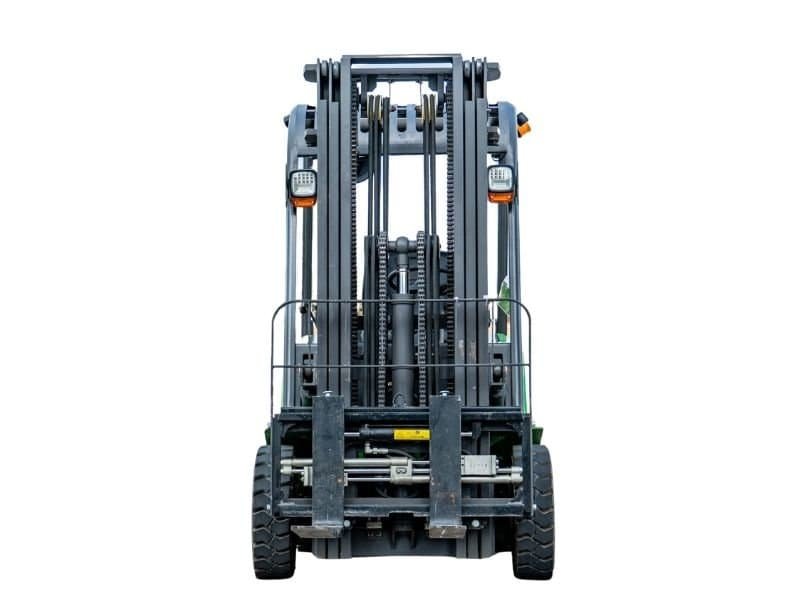
The 2 ton electric forklift is a counterbalance reference, not a promise of narrow-aisle suitability. Request its configuration-specific dimension sheet.
Validate with a Layout Trial
Use a scaled drawing or supervised on-site trial with a trained operator. Test the heaviest representative pallet and the most difficult rack position, not just an empty truck on an open floor. Check pedestrian separation during the maneuver. If the design relies on centimeter-level clearance, allow for normal variation in pallet placement and wear.
Consider productivity as well as fit. A truck that squeezes into an aisle with repeated corrections may be slower than a different truck or rack layout. Document assumptions so future pallet-size changes trigger a recheck.
Measure the Hardest Placement
Choose the rack bay that requires the most difficult approach, not the widest aisle on the drawing. Measure from the obstacles that actually limit movement: rack protectors, walls, columns and pallets projecting into the travel path. Record the pallet width and length used in that bay. A truck's turning radius is a geometric characteristic of the unloaded machine; stacking a loaded pallet is a larger maneuver.
Ask the supplier for the required right-angle stacking aisle for the exact model, mast, forks and pallet size. Include a clearance allowance appropriate to the site instead of fitting the calculation exactly to a theoretical minimum. Check the cross-aisle, dock and charging route as well; shrinking storage aisles may simply move congestion elsewhere.
Before moving racking, mark the proposed path on the floor and trial a representative load under controlled conditions. If an option such as longer forks changes the geometry, repeat the check. The useful outcome is a route that operators can execute consistently, not a nominal aisle figure that works only in an ideal drawing.
Frequently Asked Questions
Is turning radius equal to required aisle width?
No. Fork and pallet projection, approach angle and clearance also matter.
Can I use the same aisle figure for every mast option?
Confirm with the supplier; truck geometry and load assumptions may differ.
Discuss Your Forklift Requirements
Send your load weight, lift height, aisle width, duty hours and destination to Qisheng. Request a configuration and quote.