Forklift Pedestrian Safety in Shared Work Areas
News
Quick Answer
Forklift pedestrian safety improves when routes, crossings, visibility and responsibilities are designed together; a horn alone cannot manage shared space.
Find Every Conflict Point
Walk from receiving to storage and shipping while imagining both a truck and a pedestrian on the route. Identify blind corners, doors, cross-aisles, docks and places where workers retrieve fallen goods. Mark where a loaded forklift blocks its operator's forward view or where the rear of the truck swings during a turn.
Separate routes physically where practical. Where they must cross, use a clearly defined crossing procedure and sightline. Barriers should not trap pedestrians in a dead-end or interfere with emergency egress.
Design for Predictability
One-way travel, speed controls, mirrors or warning devices may help in specific places, but they need maintenance and operator compliance. High-visibility clothing is not a substitute for space separation. Make temporary changes—such as a blocked aisle or maintenance work—visible to every shift.
| Conflict | Design response to evaluate |
|---|---|
| Blind intersection | Controlled crossing and sightline improvement |
| Busy dock | Separate pedestrian access |
| Reverse travel | Clear route and site-specific procedure |
| Shift change | Briefing on temporary traffic changes |
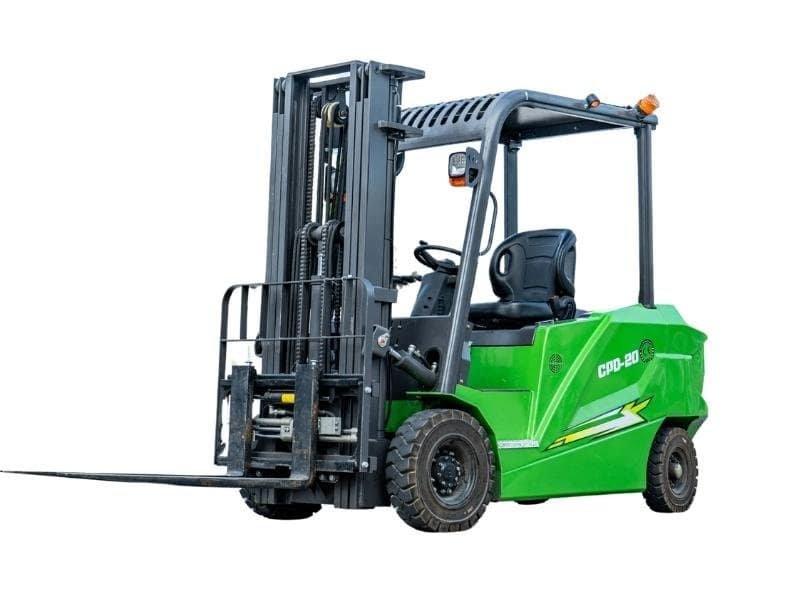
The 2 ton electric forklift shown on this page is a counterbalance reference. Check its actual turning envelope when deciding barrier positions.
Review Training and Incidents
Train drivers and pedestrians on the same traffic map. Pedestrians should know that a forklift has rear-end swing and may need additional room with a load. Operators should follow the truck manual and local procedures if visibility is restricted. Review near-misses to discover whether the layout, schedule or behavior needs adjustment.
For U.S. operations, OSHA's powered industrial truck standard provides a regulatory baseline. The most useful site plan is one workers can actually follow during the busiest hour.
Investigate the Conflict Points
An aisle map should show where pedestrians cross a truck route, where a rack or stacked pallet blocks the view and where trucks reverse into shared space. Count the crossings during a normal shift rather than relying on a quiet site visit. A door that opens directly into a travel lane can remain a serious risk even if operators know it exists.
First ask whether the routes can be separated physically or by schedule. Where a shared point cannot be removed, improve sight lines, provide clear right-of-way rules and train both drivers and pedestrians in the site's procedure. Audible or flashing warnings may help, but they do not replace separation or attentive operation. The design must account for visitors and contractors who do not know the usual pattern.
After any near miss, record the location, time, load and visibility conditions. A cluster at one crossing is evidence that the layout needs review, not merely another reminder poster. When purchasing a new truck, ask how its dimensions, operator view and warning devices will interact with the existing pedestrian plan. The safest machine choice is inseparable from the route it will use.
Frequently Asked Questions
Is a flashing light enough at an aisle crossing?
No. It may be one layer; route control, visibility, training and separation remain important.
Who needs pedestrian-route training?
All workers and visitors who may enter forklift operating areas need appropriate site instructions.
Discuss Your Forklift Requirements
Send your load weight, lift height, aisle width, duty hours and destination to Qisheng. Request a configuration and quote.