How Much Does a Wheel Loader Weigh: Specs, Cost and Buying Tips
News | September 20, 2026 | Updated October 11, 2026
Quick Answer
A wheel loader’s weight depends on the model and its fitted equipment. The examples below range from 800 kg for the NM-L904 to 16,000 kg for the NM-L50A. Larger wheel loaders can weigh more.
For transport, use the weight of the machine you will actually receive. A model described as a “2-ton loader” may refer to its rated load: the NM-L2TON, for example, has a listed machine weight of 5,300 kg and a rated load of 2,000 kg.
Real Weight Examples: Machine Weight and Rated Load
These figures come from Nuoman Machinery’s August 2026 equipment catalog.
| Catalog model | Listed machine weight | Listed rated load |
|---|---|---|
| NM-L904 | 800 kg | 400 kg |
| NM-L920 | 3,800 kg | 1,200 kg |
| NM-L2TON | 5,300 kg | 2,000 kg |
| NM-L50A | 16,000 kg | 5,000 kg |
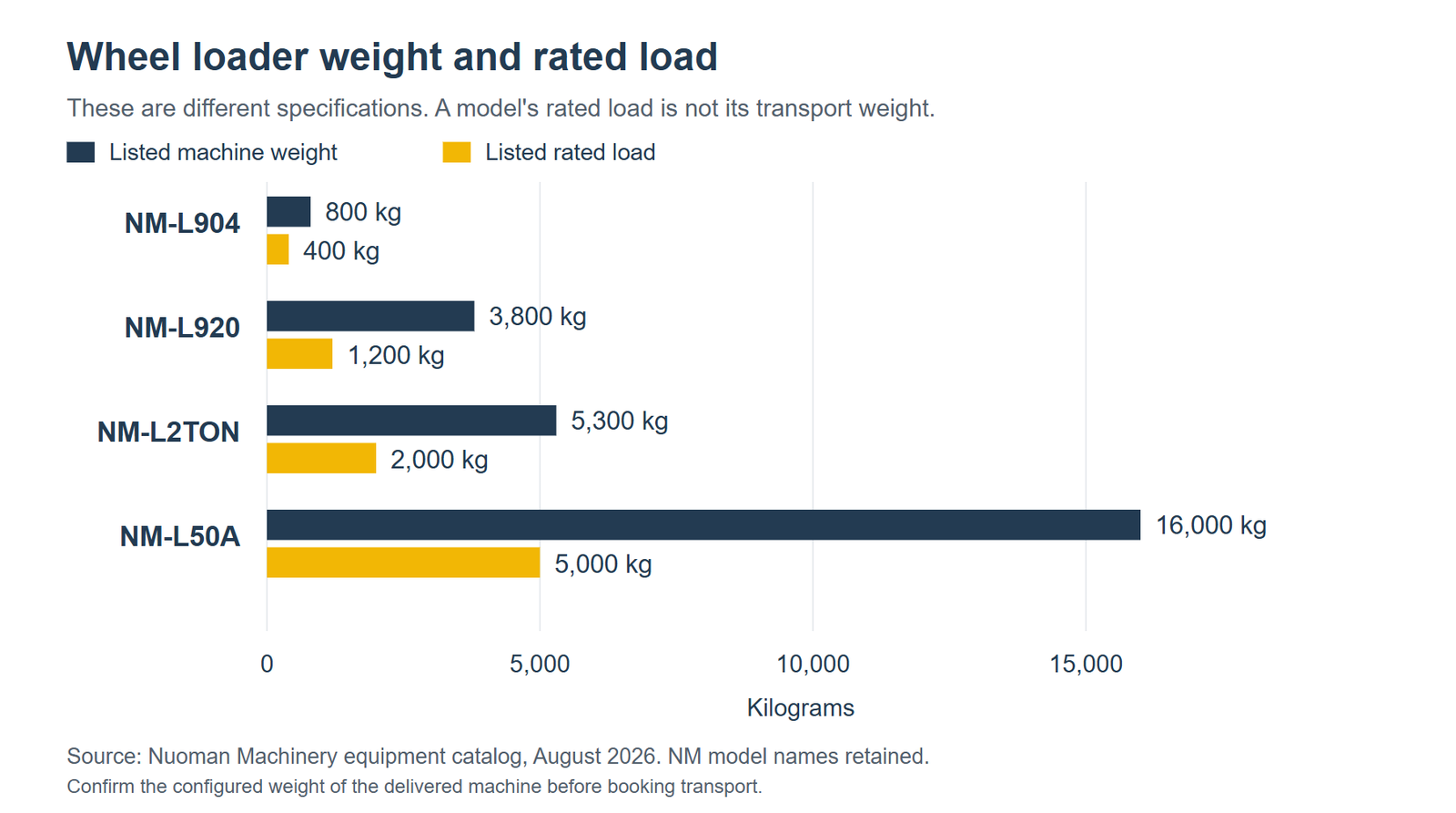
Machine weight tells you how much equipment you need to transport. Rated load describes a different capability: the material load listed for that model. Neither figure, by itself, tells you the safe lifting capacity with a different attachment or at every boom position.
This distinction changes a transport decision immediately. Booking transport for 2,000 kg because the quotation says “2-ton loader” would substantially understate the NM-L2TON’s listed machine weight.
Why Two Brochures Can Show Different Weights
Check what each figure includes. Operating weight, shipping weight and a supplier’s unspecified “machine weight” should not automatically be treated as the same measurement.
For example, Caterpillar’s UK specification for one Cat 950 configuration lists an operating weight of 19,260 kg. Its configuration note includes fluids, the operator, a specified bucket, tires and counterweight. That number belongs to the stated configuration, not every machine carrying the 950 name.
A different bucket, quick coupler, cab, tire package or counterweight can change the weight of the loader you receive. Ask the seller for the weight with your ordered equipment fitted, and whether the quoted figure includes the bucket and fluids. This prevents you from adding an item twice or leaving it out altogether.
For a used machine with changed attachments, a current weight record is more useful than a brochure for its original configuration.
Calculate the Load Your Trailer Must Carry
Start with the configured machine weight, then add everything else carried on the trailer. Keep the trailer’s own empty weight separate.
Here is an illustrative calculation, using the NM-L2TON’s catalog figure and assumed cargo weights:
| Item | Weight |
|---|---|
| Machine, assuming the listed configuration matches the delivered unit | 5,300 kg |
| Separately carried attachments | 300 kg, assumed |
| Restraints and other cargo | 100 kg, assumed |
| Total carried load | 5,700 kg |
Now suppose a trailer has a maximum loaded mass of 7,500 kg and an empty weight of 2,000 kg. Its available payload is 7,500 − 2,000 = 5,500 kg. The 5,700 kg load would exceed that allowance by 200 kg, even though the loader alone weighs less than 5,500 kg.
These assumed trailer figures demonstrate the calculation. Selecting transport also requires checking the actual trailer, axle, ramp, coupling and tow-vehicle ratings. A payload calculation does not establish that the complete combination is suitable.
What to Send for a Delivery Quote
Give the haulier the configured weight, overall length, width and height, plus the weights of any loose attachments. Describe the loading and unloading arrangements at both ends of the journey.
This information helps explain differences between freight quotes. A larger loader may require different transport equipment or unloading arrangements. Compare the machine price and delivery price separately, then add them together for the delivered cost. There is no reliable freight price that can be calculated from the loader’s rated load alone.
When comparing wheel loader sizes, keep access dimensions and transport weight on the same worksheet. A machine that fits the site may still exceed the capacity of your existing transport.
Frequently Asked Questions
Is a 2-ton wheel loader a machine that weighs 2,000 kg?
Not necessarily. The number may describe rated load rather than machine weight. The NM-L2TON catalog example lists a 2,000 kg rated load and a 5,300 kg machine weight. Read the specification labels rather than relying on the model name.
Should I add the bucket weight to the brochure weight?
Only if the stated machine weight excludes that bucket. If the standard bucket is already included, adding it again overstates the load. A separately transported spare bucket still needs to be counted.
Can I use lifting capacity to choose a trailer?
No. Use the actual transported weight of the machine and cargo. Lifting capacity answers a different question about the loader’s work capability.
Sources and Model Information
Model figures: Nuoman Machinery equipment catalog, August 2026, printed pages 10–13 and 18–19. Weight definition example: Caterpillar’s UK Cat 950 specification. Payload terminology: Brian James Trailers’ weight guide. Online sources checked October 11, 2026. The transport example uses explicitly assumed cargo and trailer figures.
Browse the loader range or send Qisheng the model and attachment configuration to request the weight and delivery details for a quotation.