Narrow Aisle Forklift Guide for Warehouse Planners
News
Quick Answer
A narrow aisle forklift is selected around rack geometry and floor conditions, not just its body width; confirm the full turning or travel envelope with your pallet.
Measure the Actual Aisle
Nominal rack spacing can overstate usable width. Pallet overhang, upright guards, stored loads and columns reduce clearance. Survey the narrowest point and cross-aisles. Record pallet width and depth, plus the direction in which forks enter. Then request an aisle calculation for each proposed truck and mast.
Narrow-aisle equipment can improve storage density, but it may need smooth, level floors and a compatible rack design. A standard counterbalance truck might still be better for mixed dock work where turns are less constrained.
Choose the Right Truck Family
Reach trucks, specialized guided machines and compact counterbalance forklifts address different constraints. A reach truck's support legs and mast reach affect pallet access. Very-narrow-aisle systems may need guidance infrastructure and disciplined floor maintenance. Decide whether the building can support these features before buying the truck.
| Layout detail | Request from supplier |
|---|---|
| Clear aisle | Calculated minimum with your pallet |
| Rack level | Capacity at required height |
| Cross-aisle | Turning and transfer allowance |
| Floor | Flatness and surface requirements |
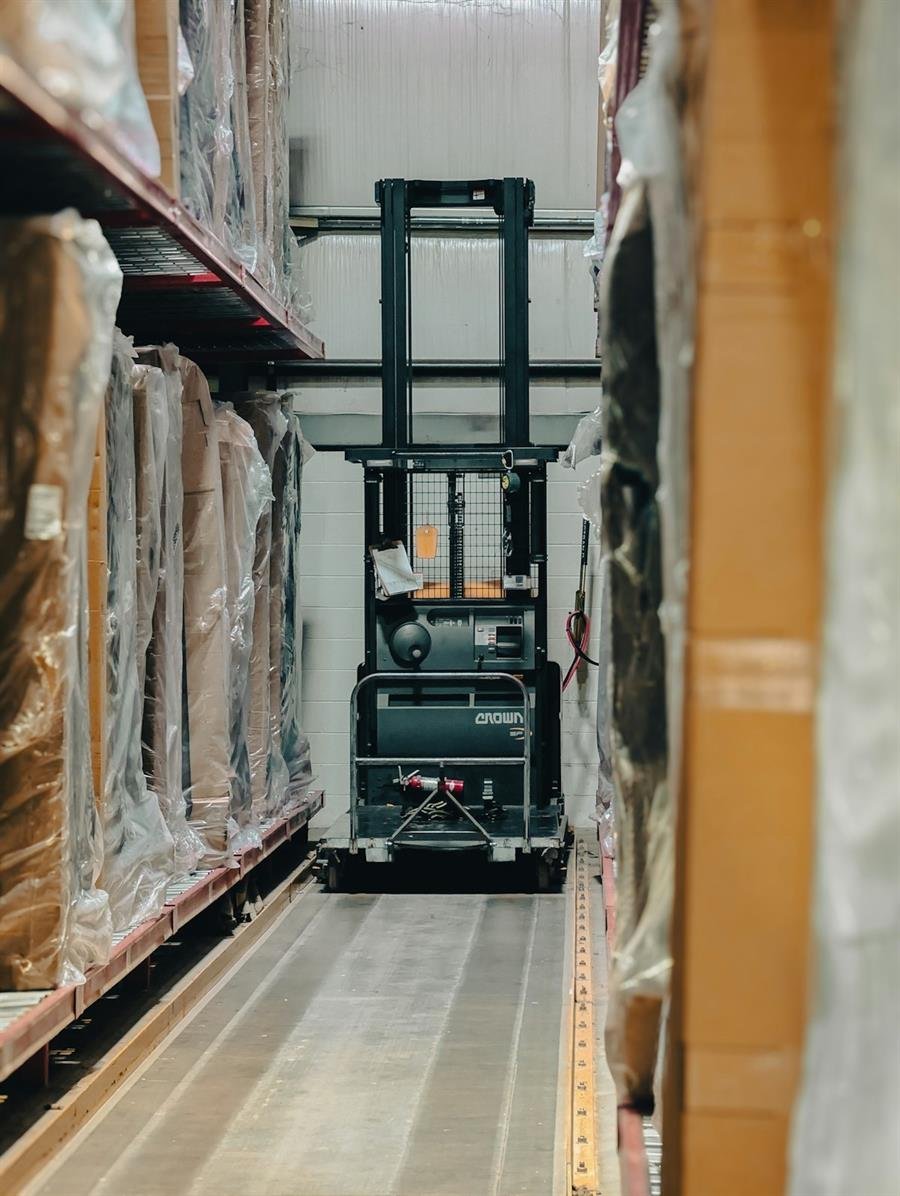
The pictured 2 ton electric forklift is a counterbalance comparison image, not proof that it will fit a specialist narrow aisle.
Test the Entire Route
Walk through dock entry, staging, cross-aisle travel and final pallet placement. Check visibility and protected pedestrian paths. A truck that fits between racks may still fail to turn out of the storage row or pass under a door with its chosen mast.
Ask for site-specific drawings, not a single “minimum aisle width” number without pallet assumptions. Include the charger or fueling route and safe parking location. When expanding an existing warehouse, confirm rack changes with the building and fire-safety requirements that apply locally.
Test the Layout After Allowances
Suppose the rack drawing shows an aisle that appears to fit a proposed truck. Subtract space occupied by rack guards, structural columns, pallets that project beyond the beam and any floor marking or pedestrian exclusion zone. The remaining clear width is the figure a truck must actually use. A brochure's turning radius cannot be substituted for its right-angle stacking requirement with your pallet.
Measure the cross-aisle where trucks enter and leave the narrow run, as well as the aisle itself. Check the highest rack position against the truck's approved load capacity at that height and the lowest door against mast height when lowered. Floor flatness and condition can also affect equipment designed for tight warehouse spaces; ask the maker for its limits.
A narrow-aisle conversion changes more than equipment cost. It may alter rack layout, pallet dimensions, guidance systems, charging space and emergency access. Before committing to more storage locations, draw the proposed truck's complete route and trial the real pallet. If the gain is only theoretical, the wider and simpler layout may be the better investment.
Frequently Asked Questions
Is a smaller turning radius enough?
No. Pallet size, mast, tail swing and clearances determine usable aisle width.
Does narrow aisle always save money?
Only if added storage capacity and throughput outweigh equipment, floor and layout costs.
Discuss Your Forklift Requirements
Send your load weight, lift height, aisle width, duty hours and destination to Qisheng. Request a configuration and quote.