Small Electric Forklift Guide for Tight Spaces
News
Quick Answer
A small electric forklift may help in a compact warehouse, but check the real turning aisle, load center, mast clearance and battery plan before prioritizing footprint.
What “Small” Should Describe
Compactness can mean shorter overall length, narrower body, smaller turning radius or a lower mast. These are different measurements. A truck may look narrow yet need more turning space with a long pallet. Start by measuring the clear route and the load dimensions, then compare dimensioned equipment drawings.
If your goods are light and remain near the floor, a pallet stacker may be more economical. If full pallets must reach racks, verify the proposed electric truck's capacity at height and whether its forks fit the pallet pockets.
Examine the Space and Energy Trade-Off
Electric operation is useful where local exhaust is undesirable, but a compact chassis does not eliminate charging needs. Check charger position, electrical supply and time between shifts. Also compare battery size with the actual travel and lift workload rather than a quoted “hours per charge” without context.
| Space constraint | Measurement needed |
|---|---|
| Narrow aisle | Clear width with pallet and protection |
| Low door | Mast lowered and guard height |
| Tight turn | Turning data with selected pallet |
| Small charging room | Charger clearance and electrical plan |
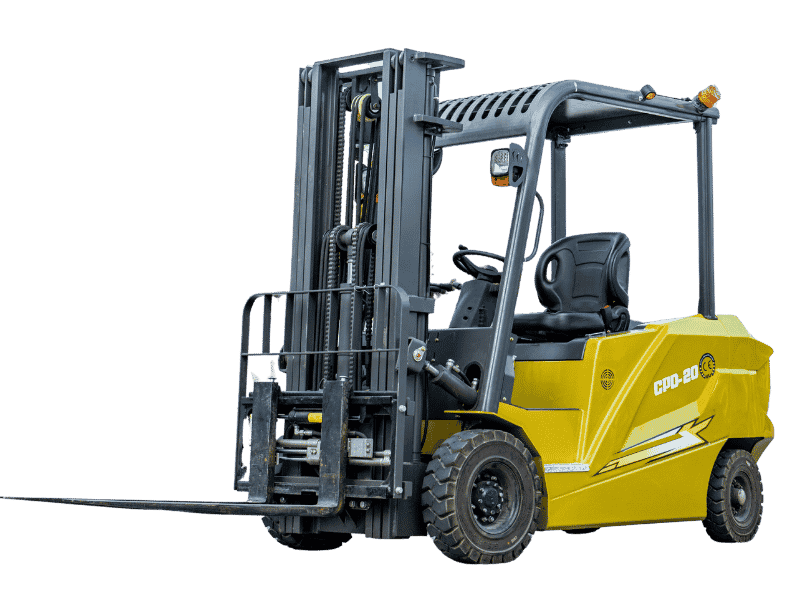
The 2 ton electric forklift shows one electric counterbalance configuration. It should not be labeled a specialist narrow-aisle truck without model-specific dimensions.
Create a Shortlist that Works
Ask each supplier to quote the exact mast, forks, battery, charger and tire type. Provide a sketch showing rack faces, cross-aisles and the heaviest pallet. Request proof that the configuration clears the route and lifts the load to the required height. Operators should trial the visibility and controls under normal site conditions.
Do not sacrifice a safe load rating for a few centimeters of nominal body width. A small truck that must make repeated extra moves can reduce throughput. Compare whole-route travel time, service access and parts availability before purchase.
Define “Small” with Three Measurements
Different buyers use “small” to mean short overall length, a narrow body or a tight turning circle. Write down which of these is limiting the work. A compact truck that turns in a corridor can still fail if the mast cannot pass a doorway or if the loaded pallet extends beyond the available aisle.
Check the lightest and heaviest routine tasks rather than buying only for the smallest pallet. Note the maximum rack height, door clearance and whether the route has a dock or outdoor section. Ask for the manufacturer's aisle requirement with the proposed pallet size and fork length; an empty-truck turning radius alone is not a complete stacking measurement.
The electric system deserves the same attention as the dimensions. Identify where the truck can charge without blocking traffic and whether the available charger fits the battery and shift. A small footprint is useful when it unlocks a real layout benefit, but it should not force an undersized battery or a load rating that leaves no room for normal work. Compare a measured plan against the exact model drawing before ordering.
Frequently Asked Questions
Is a compact electric truck always cheaper?
Not necessarily. Mast, battery, charger and service choices affect total cost.
Can a 2 ton electric truck fit any narrow aisle?
No. Aisle requirements depend on truck geometry, pallet length and turning method.
Discuss Your Forklift Requirements
Send your load weight, lift height, aisle width, duty hours and destination to Qisheng. Request a configuration and quote.