Stand-Up vs Sit-Down Forklift: How to Choose
News
Quick Answer
A stand up forklift can suit frequent on-and-off tasks or specialized aisle layouts; a sit-down truck may better fit longer travel, but capacity and operator environment decide.
Compare the Work Patterns
Stand-up designs often prioritize easy entry and exit and can be used in certain high-density warehouse workflows. Sit-down counterbalance trucks provide a different driving posture and may be preferred for longer travel or mixed dock routes. Neither posture alone tells you the machine's rated capacity, turning radius or rack reach.
Track one shift: how often does an operator mount and dismount, how far do pallets travel, and where must the truck turn? A site with repeated short picks needs a different ergonomic review from a yard with sustained travel. Test the intended truck design with trained operators and the actual route.
Aisles, Visibility and Loads
Stand-up and sit-down trucks can use different steering layouts and operator orientations. Verify the operator's view toward pedestrians, racks and the travel direction. Door clearance, mast options and battery or fuel arrangements also vary by model; do not infer them from posture.
| Question | Stand-up emphasis | Sit-down emphasis |
|---|---|---|
| Task rhythm | Frequent short stops | Longer continuous travel |
| Site fit | Check specialized aisle geometry | Check counterbalance turning room |
| Comfort review | Entry, exit and standing fatigue | Seat, restraint and visibility |
This is a screening table, not a universal ranking. The two truck types may differ in many other ways. If you are comparing a reach truck with a sit-down counterbalance unit, you are also comparing mast reach and aisle system—not just standing versus sitting.
Make a Site-Specific Choice
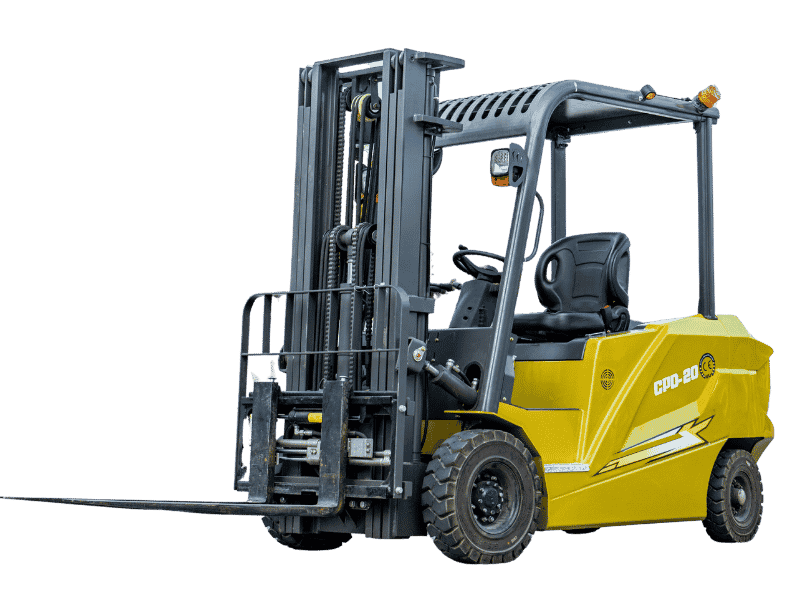
Ask suppliers for a layout drawing using your pallet dimensions and rack coordinates. Compare load data at required height, floor load limits, doorways and charging or fueling arrangements. The pictured 2 ton electric forklift is a sit-down-style counterbalance reference; it is not a stand-up product.
Have trained staff evaluate both formats under normal traffic conditions. In the United States, OSHA requires training to cover truck-specific and workplace-related topics. A purchase decision should incorporate that adaptation and service support, not merely an operator-preference poll.
Compare a Full Shift, Not One Turning Circle
A short demonstration can make a stand-up machine look attractive in tight aisles, but the comparison should include the whole shift: number of stops, direction changes, pallet placements, travel distance, dock crossings and time spent waiting. A sit-down truck may fit a longer route differently from a machine optimized for frequent in-and-out warehouse movement.
Ask operators and supervisors to document visibility at blind intersections and during reverse travel, the space needed to enter and exit the operator compartment, and any restraint or training requirements for each model. These are equipment-specific questions; an operator experienced on one truck should still be trained and evaluated on another design as required by the workplace. OSHA's training provision is a starting reference for U.S. sites.
For a buyer, request the same load and rack test with both candidate machines. Record whether either truck needs a changed aisle or charging arrangement. The result may favor a different design for a high-turnover warehouse than for a yard with long, uninterrupted travel.
Frequently Asked Questions
Is a stand-up forklift always narrower?
No. Check exact dimensions and aisle requirements for the proposed model and load.
Which is better for all-day use?
It depends on travel distance, stop frequency, floor condition and individual ergonomic assessment.
Discuss Your Forklift Requirements
Send your load weight, lift height, aisle width, duty hours and destination to Qisheng. Request a configuration and quote.