Attachments for Mini Excavator: Compatibility Checklist
Qisheng Machinery · Updated October 16, 2026
Quick Answer
Choosing attachments for mini excavator work requires more than a matching size label. Confirm the mechanical interface first, then check the hydraulic supply, return circuit and controls required by each powered tool. Identify the exact carrier and attachment models in the compatibility record.
A bucket that mounts correctly may still have unsuitable mass or geometry. A hydraulic tool with matching hose connectors may still require a circuit or flow setting the machine does not provide. Obtain written confirmation for the complete combination before ordering or commissioning it.
Build a Machine-and-Tool Compatibility Record
| Check | Carrier information | Attachment information | Match to confirm |
|---|---|---|---|
| Identity | Model, serial/version and installed coupler | Maker, model and mounting version | The drawing and specifications apply to the actual pair |
| Mechanical interface | Pin diameter, pin centers, mounting width and coupler details | Matching dimensions and locking arrangement | Mount fits and locks as intended, without improvised substitution |
| Mass and geometry | Manufacturer's permitted attachment arrangement and relevant ratings | Tool mass including mount and accessories, geometry and load | Combination stays within the carrier's stated limits |
| Hydraulic supply | Available auxiliary flow and pressure for the selected circuit | Recommended operating range and limits | A permitted operating setting exists for both |
| Return and drain | Return routing, permitted pressure and any drain connection | Return/back-pressure limits and case-drain requirement | Required paths exist and are configured correctly |
| Control and services | One-/two-way function, continuous flow or electrical services available | Rotation, reverse, switching and other required functions | The operator can control every required function |
Keep units alongside every value. Do not compare a flow in gallons per minute with a number in liters per minute without converting on the correct gallon basis. A connection drawing is preferable to a photograph with no dimensions.
Measure the Mount and Identify the Lock
For a pin-on tool, record the relevant pin and mounting dimensions from the actual equipment or its applicable drawing. Similar-looking ears and pins do not prove compatibility. For a coupler-mounted tool, identify both the coupler system and the approved attachment interface.
Check how the attachment is retained and how correct engagement is verified under the manufacturer's instructions. A quick hitch can introduce its own geometry and operating requirements. Do not assume a coupler makes any bucket or auger suitable for the carrier.
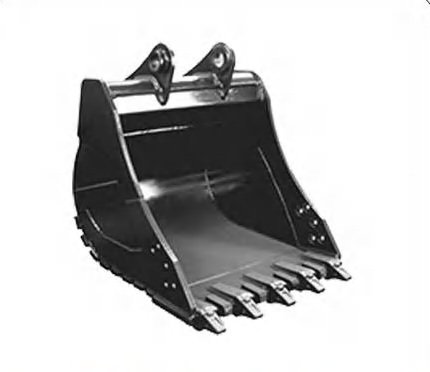
Qisheng's v9 catalogue lists digging-bucket widths of 400 mm for QS-12 and QS-18, and 420 mm for QS-25. Those widths describe the bucket, not the pin diameter, pin centers or coupler system. The catalogue does not supply a complete mounting drawing for every combination. Use the bucket dimensions guide when collecting bucket interface measurements.
Read Auxiliary Flow Instead of Main Pump Output
The value a powered attachment needs is the available supply at its specified circuit and operating conditions. Main pump output is not automatically the flow delivered to an auxiliary connection.
For a clear published example, Cat's 301.5 U.S. specification lists pump flow at 2,400 rpm as 66 L/min, primary auxiliary flow as 33 L/min and secondary auxiliary flow as 14 L/min. These are Cat figures, not Qisheng ratings. They show why copying the largest hydraulic-flow number into an attachment order can produce the wrong match.
Ask for the selected QS configuration's auxiliary supply range, pressure information and return/drain arrangement. Those ratings are not established in the Qisheng catalogue used here. They cannot be calculated reliably from an engine-power entry, ton-class name or a photograph of two hoses.
Check the Circuit and Commission the Combination
An auger normally needs the rotation functions specified by its maker, including any required reverse operation. A breaker has different supply and return requirements. Some tools require a separate case drain; others do not. Matching the connectors or adding an adapter does not create a missing circuit or establish acceptable return pressure.
Send both equipment specifications to the party confirming the installation. Require the appropriate hoses, connectors and control arrangement to be identified, and ask whether any additional valve, drain line or electrical connection is part of the supplied kit.
Commissioning should follow the carrier and attachment instructions, including their locking, circuit-setting and initial test procedures. Have the responsible technician resolve missing ratings or incompatible settings before use. This checklist is an information record; it does not replace a model-specific installation procedure.
Frequently Asked Questions
Are attachments universal within a mini excavator size class?
No. Machines of similar nominal size can have different interfaces, auxiliary circuits and permitted tool arrangements. Match the actual models and configuration drawings.
Can I make a hydraulic attachment fit by changing its couplers?
Couplers address one connection detail. The flow, pressure, return/drain circuit, controls and mechanical installation still need confirmation. A physical connection alone is insufficient.
What should I send Qisheng if I already own an attachment?
Send its model plate, manual or specification sheet, mount dimensions, tool mass and hydraulic/control requirements, plus photographs of the connection arrangement. Ask for confirmation against the exact proposed QS machine version.
Related Tools and Models
Read the auger size and drilling guide for hole and ground requirements. Use the accessories guide to decide which equipment is needed, and the assembled order guide to record what will be delivered.
Compare QS-12 and QS-18 with your tool requirements, then request a configuration and compatibility review from Qisheng. Include the technical record with the price enquiry.