Mini Excavator Attachments: Complete Guide for 2026 (Part 1)
News | September 07, 2026 | Updated October 14, 2026
Quick Answer
Choose mini excavator attachments by the material you need to handle and the result you need to achieve. In this first part, the two tools are the digging bucket, which excavates and contains material, and the rake, which draws together or separates suitable loose debris through its tines.
A rake is not a replacement for a bucket when you need to remove a measured volume of soil. Neither tool can be ordered safely from the machine’s nominal tonnage alone: its mounting, weight and intended duty must suit the exact excavator.
Digging Bucket: For Excavation and Material Removal
A digging bucket suits work where the excavator must cut into soil, collect it and discharge it elsewhere. For drainage or footing work, the excavation dimensions determine the useful bucket width. The ground and machine determine whether that bucket is suitable for the duty.
Qisheng’s current catalog lists a 400 mm bucket width for QS-12 and QS-18 models, and 420 mm for QS-25 models. Those values describe the listed buckets. They do not establish the volume of an alternative bucket or make every 400 mm bucket interchangeable.
For a trench, choose against the designed excavation width before buying a wider tool for its apparent capacity. Unnecessary width means more soil to remove and potentially more bedding or backfill. The bucket dimensions guide shows a worked volume comparison.
A bucket also carries its own weight. Its empty weight and the material it contains must remain suitable for the excavator and working position. Oversizing does not guarantee faster production; Bobcat’s bucket guidance specifically cautions that oversized buckets can impair performance and cycle times.
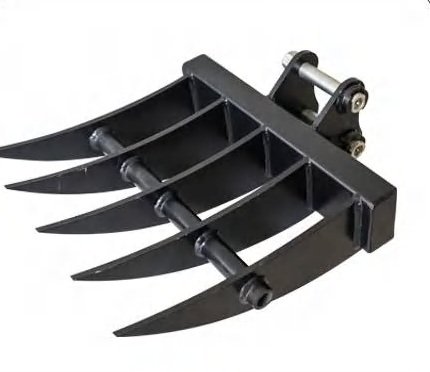
Rake: For Separating and Gathering Suitable Debris
A rake has spaces between its tines rather than a closed bucket shell. That makes it useful when the task calls for gathering branches or separating suitable debris while allowing some loose soil to pass through.
For example, a landscaping job may require excavating a planting area and gathering loose woody debris from the surface. The bucket handles the soil removal; a compatible rake may help gather the debris afterwards. The tools solve different parts of the job.
How well a rake separates material depends on tine spacing and the material. Wet clods may remain with the debris, while small fragments can fall between the tines. Ask for the tine spacing, overall width and attachment weight, not just a photograph labelled “land-clearing rake.”
A rake listing also does not establish that the excavator can pull out a particular stump, break concrete or carry suspended loads. Those duties need their own machine and attachment assessment. Gathering surface debris and extracting an established root system are different requirements.
Bucket or Rake: Match the Tool to the Result
| Required result | Tool to assess | Information to confirm |
|---|---|---|
| Remove soil to a specified width and level | Digging bucket | Cutting width, capacity, weight and mounting |
| Gather suitable loose branches or debris | Rake | Tine spacing, working width, weight and approved duty |
| Separate debris while retaining some soil on site | Rake or an appropriate screening tool | Material condition, fragment sizes and separation required |
| Finish a smooth surface | A suitable grading bucket or other finishing equipment | Required finish and compatibility; a rake alone does not establish compaction |
Confirm Compatibility Before Ordering
Provide the exact excavator model and the mounting drawing. For a pin-mounted tool, identify pin diameters, pin-centre distance and the space between the mounting ears. For a quick coupler, identify the coupler model and the dimensions it accepts.
Ask the supplier to confirm compatibility in writing, including attachment weight and any limits on use. “Fits most mini excavators” leaves too much unresolved. Matching one pin diameter does not prove that the second pin position, bracket width or coupler geometry is correct.
A fixed bucket or rake does not automatically need an additional hydraulic circuit. A powered or hydraulically tilting version may. Specify the exact attachment rather than treating all tools with the same general name as identical.
Frequently Asked Questions
Can I order one bucket and use it on several machines?
Only after confirming the mounting, weight and approved suitability for each machine. A common width or similar class name is insufficient evidence.
Should I buy a complete attachment package immediately?
Start with the tools needed for confirmed work. Price future attachments separately and verify the excavator’s required circuits and mounting arrangements before ordering them.
Sources and Attachment Enquiries
Qisheng catalog, October 9, 2026: QS-12, QS-18, QS-25 and Optional Accessories pages. The accessory page illustrates available tool types; it is not a compatibility table for every model. External bucket guidance is linked above.
Send Qisheng your machine model, mounting dimensions and the material to be handled for an attachment-specific quotation.