Mini excavator hydraulic pumps: identify the unit before replacement
Identify a mini excavator hydraulic pump by its complete manufacturer code and installed arrangement before ordering a replacement. Keep the diagnosis separate: slow movement, heat or noise alone does not prove that the pump has failed.
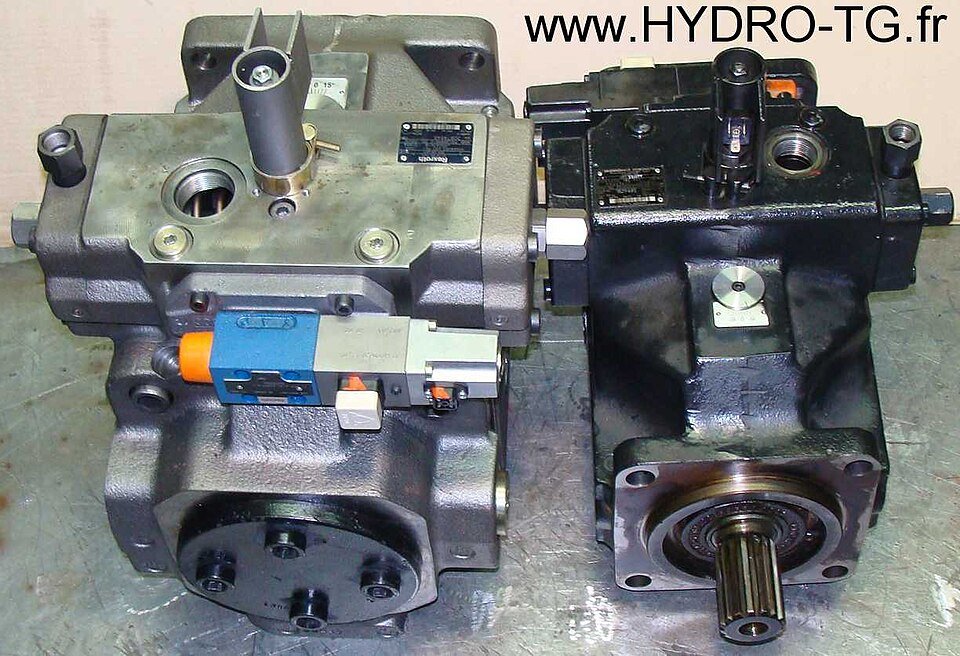
(User:Thielleux)
; Public domain. Resized for web display; no content retouch.Ask the service provider to define the fault and the approved repair scope. Once replacement is justified, collect the unit identity, drawings and connection details. A similar casting or the same mounting-hole count cannot establish equivalence.
Start with the complete unit code
Record the pump maker, full model/code, serial or production identification, and any stamped rotation arrow. Photograph the unit in place and its markings without entering an unsafe service area. Keep all letters and suffixes; they may describe different shafts, ports or controls.
Danfoss’s Lumi Group 2 technical information, for example, describes a family with displacements from 5.1 to 24.0 cm³/rev and multiple mounting, port and shaft options. A family name therefore leaves substantial choices unresolved. These are Danfoss reference designs, not the specification of a Qisheng pump.
| Identification field | What the order needs |
|---|---|
| Pump construction | The approved unit type and number of sections. |
| Displacement | cm³/rev for each section, with the full unit code. |
| Mount and shaft | Flange/pilot drawing, shaft form and coupling arrangement. |
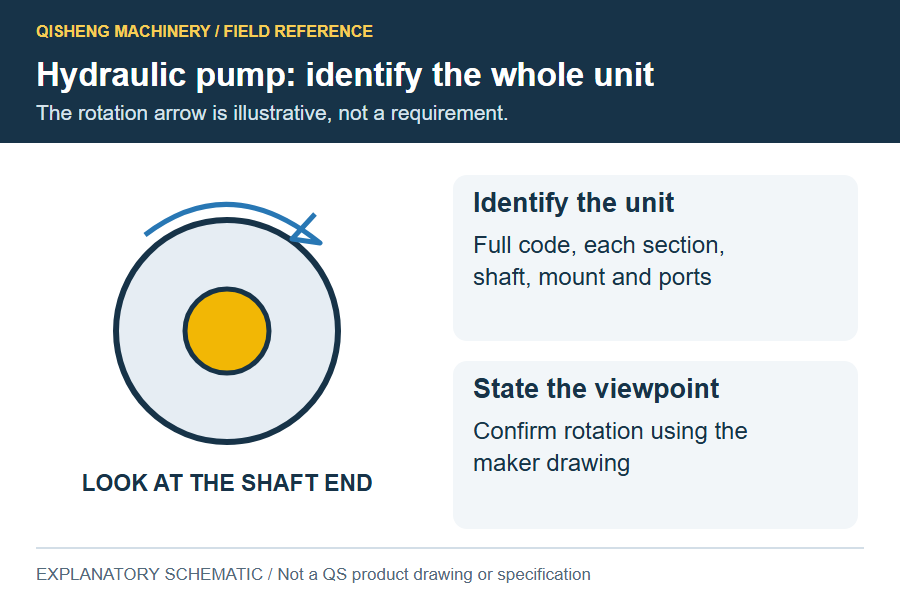
| Rotation | Direction and the maker’s defined viewing end. |
| Ports and controls | Inlet, outlet, drain or control ports as applicable, including orientation. |
State the rotation viewpoint
The Danfoss installation information defines rotation viewed from the pump’s drive-shaft end. Its Rugid coding information likewise identifies rotation from the drive shaft.
Write the viewpoint beside CW or CCW on the request. A photograph taken from the opposite end reverses what an observer sees. An engine document’s flywheel-view direction also needs its own interpretation; copying the word “clockwise” from another component can give the wrong result.
Have the supplier identify the ports from the actual drawing. Do not treat the larger-looking opening or a hose’s route as a universal way to infer rotation.
Understand what a displacement change would do
For a fixed-displacement pump, theoretical flow in L/min is displacement in cm³/rev × speed in rpm / 1,000. Real delivered flow also depends on operating conditions and losses.
Consider an illustrative comparison at an assumed 2,500 rpm. A 12 cm³/rev pump gives 30 L/min theoretical flow; a 20 cm³/rev pump gives 50 L/min. These are arithmetic examples, not installed QS pump ratings.
At an assumed 100 bar, ideal hydraulic power is pressure × flow / 600. The corresponding results are 5.0 kW and approximately 8.33 kW, before losses. More displacement can therefore create an engine-power demand that the rest of the system was not designed to supply.
A “Chinese mini excavator hydraulic pump upgrade” needs a complete engineering review of the drive, inlet, valves, lines, cooling and permitted operating conditions. Changing a pump or pressure setting from an online suggestion can overload components. The auxiliary hydraulics guide explains the separate distinction between total pump flow and usable tool supply.
Investigate why the original unit failed
Before fitting another unit, have the service provider assess the applicable causes and contamination response. The Danfoss installation guidance addresses fluid cleanliness, inlet conditions and drive alignment. A replacement can be exposed to the same problem if the original cause remains.
Retain any inspection report, authorised test results and the required cleaning or component work. Use the actual pump and machine instructions for commissioning. This identification process does not supply a generic pressure test, priming routine or adjustment value.
Request a confirmed replacement specification
Send Qisheng or the component supplier the machine serial, complete pump markings, safe-location photographs and the service diagnosis. Request the proposed replacement’s full code and drawing, together with written confirmation of the relevant installation and operating requirements.
After the approved repair, record the fitted identity and work completed in the maintenance record. Keep the diagnosis, purchase and commissioning evidence together so a later fault can be assessed against what was actually fitted.