Mini Excavator Pallet Forks: Fit and Load Information
Qisheng Machinery · October 18, 2026
Quick Answer
Select mini excavator pallet forks from the load, pallet openings and complete machine-to-fork arrangement. Check the tine length, spacing, fork rating, attachment mass and the carrier's applicable load information together. A rating marked on the forks does not state how much the excavator can handle in every position.
Begin with what will actually be moved: its measured mass, dimensions, centre of gravity and destination. A wrapped pallet may contain unevenly distributed goods, while an empty pallet's dimensions say nothing about the load on it.
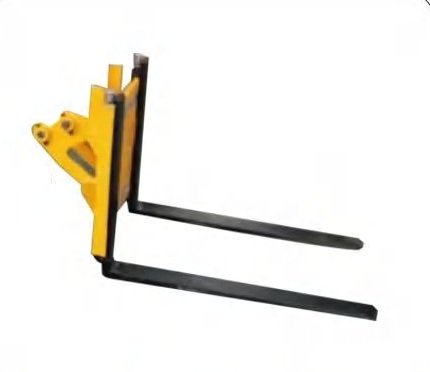
Measure the Load and the Fork Arrangement
Qisheng's accessories catalogue illustrates a two-tine fork attachment. For an order, obtain the supplied model, drawing and stated duty. Confirm whether spacing is fixed or adjustable and how the tines are retained. Those details should come from the offered tool, not a similar photograph.
| Measurement or feature | Purchase question it answers |
|---|---|
| Pallet entry opening | Will the tine section fit the intended entry? |
| Tine length | How does the permitted support arrangement relate to the load depth? |
| Tine spacing and adjustment range | Can the approved setup match the pallet or material? |
| Frame width | Does the assembly fit the receiving space and access route? |
| Load centre | Where is the load's centre of gravity relative to the specified fork reference? |
| Retention and support design | How are the tines secured and the attachment stored as instructed? |
As a geometry example, a uniformly distributed load 1,000 mm deep would have its centre halfway through that depth, at 500 mm from its rear face. This is a hypothetical measurement example, not a QS rating. Packaging, overhang or an uneven stack can change the actual centre of gravity.
Do not choose tine length by assuming a longer fork automatically permits a heavier load. Obtain the manufacturer's required support and load-position information for the goods being handled.
Read Tool Ratings Separately from Carrier Capacity
Engcon's GH1000L lightweight fork page gives a clearly labelled manufacturer example:
| GH1000L reference | Published figure |
|---|---|
| Frame width | 1,000 mm |
| Standard tine length | 800 mm |
| Mechanical version weight | 141 kg |
| TP500 tool rating | 2 tonnes at a 500 mm load centre |
Engcon describes this product for its stated 2–6 tonne carrier class and S40 connection. These are Engcon's figures, not Qisheng fork data or an approval on a QS model. The 2-tonne figure is the fork's rating at the stated load centre; it cannot be assigned to an excavator simply because the tool is attached.
The carrier review also needs the complete installed equipment and the positions in which the load will be handled. State the fork, coupler, adapter or tiltrotator arrangement. Use the actual chart and its inclusion or deduction notes; do not subtract weights from an unrelated headline capacity to invent an allowable payload.
Keep the detailed machine-chart definitions in the mini excavator lifting-capacity guide. This fork enquiry adds the supported load and tine geometry that a general lifting question does not establish.
Specify the Handling Task and Installation
When comparing pallet forks for a mini excavator, describe the starting and receiving positions as well as the pallet. A delivery vehicle, loading area or storage rack introduces its own height, access and clearance requirements. The responsible site team must confirm the permitted handling method and equipment.
Some mini excavator forks use manually adjusted tines; other assemblies provide hydraulic adjustment. Ask which function is included. Hydraulic spacing, fork tilt and a tiltrotator are separate features and may require different controls or protection components.
Have the manufacturer or installer confirm the complete interface and any required load-holding equipment. Engcon's pallet-fork guidance specifically requires an appropriate load-holding valve when its forks are used with a tiltrotator. That product requirement illustrates why the complete assembly needs review; it is not an installation specification for an unidentified QS setup.
If the job requires repeated pallet movement through a defined aisle or placing goods at a regular storage height, compare equipment designed for that task as part of the purchase decision. Fitting forks alone does not provide all the features or operating permissions of a dedicated forklift.
For acceptance, ask for identifiable tool documents, the approved machine configuration and the agreed checks. Keep people clear of the handling area and use the relevant manufacturer and site procedures. A photograph of an excavator holding an unknown pallet is not a load-rating record.
Frequently Asked Questions
Can I use the fork's marked capacity as the machine's capacity?
No. Review the fork rating and the carrier's applicable information for the complete arrangement. Both must suit the proposed task.
Do fixed forks need an auxiliary hydraulic circuit?
A fixed mechanical tool has no powered tine-adjustment function. Confirm the supplied assembly; hydraulic adjustment or other powered features create additional requirements.
Can a pallet size tell me its centre of gravity?
Only under a stated load-distribution assumption. Identify the goods, their mass and how they are arranged; an uneven load needs its actual information.
Related Information and a Fork Quote
Use the mounting and hydraulic compatibility guide and quick-coupler guide to identify the installed interface. Review QS-18, QS-25 and the Qisheng catalogue. Send the pallet, known load information and receiving arrangement to Qisheng for a defined tool and carrier review.