Are Mini Excavator Buckets Universal?
Qisheng Machinery · Updated October 16, 2026
Quick Answer
Mini excavator buckets are not universal. Check the pin interface or dedicated coupler system, then confirm the bucket's mass, geometry and intended duty on the actual machine. Matching nominal tonnage or cutting width is insufficient.
Start by identifying how the bucket connects: directly to the arm and linkage, through a pin-grab coupler, or through another dedicated interface. The connection method determines which drawings and dimensions must be compared.
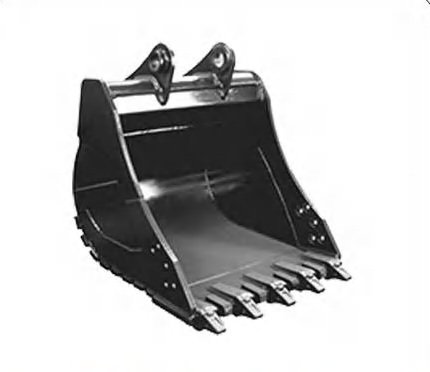
Separate Cutting Width from Mounting Dimensions
Cutting width describes the excavation edge; it does not describe the mount. Qisheng's v9 catalogue lists 400 mm digging buckets for QS-12 and QS-18, and 420 mm for QS-25. The two 400 mm listings do not establish identical pins, pin centers or internal mounting widths.
For a typical pin-on arrangement, collect the following information from the actual approved drawing or supported equipment. Use the manufacturer's dimension labels and datum points so “width” or “spacing” has only one meaning in the enquiry.
| Interface field | What to record | Common confusion |
|---|---|---|
| Pin diameters | Each relevant pin diameter separately, with units | Assuming both positions have the same diameter |
| Pin-center distance | Center-to-center dimension between the mounting pin axes | Listing “pin spacing” and “mounting center distance” as two different measurements |
| Internal mounting width | Clear width between the relevant mounting ears, referenced to the drawing | Measuring outside ear width or bucket cutting width instead |
| Pin and retention arrangement | Required working length, retainers and interface details | Treating any pin that enters the hole as suitable |
| Geometry | Mount height, tip radius and required movement envelope | Assuming dimensional pin fit proves full operating clearance |
Photograph the mount and identify the measured locations. A number without units or an annotated reference is easily misread. Obtain confirmation if ears are offset or the interface differs from the simple arrangement above.
Identify What the Coupler Actually Accepts
A quick hitch does not eliminate compatibility limits. Check its exact model, interface, accepted dimensions and locking requirements against the proposed bucket. A supplier's “universal fit” description should be supported by the particular coupler's approved application range.
Werk-Brau's SLQT coupler explanation gives a clear example: it is made for a dedicated OEM pin specification, rather than variable pin centers across different OEM attachments. Other coupler designs have different acceptance arrangements. Neither category proves that a particular bucket fits a QS machine.
Also distinguish the pins on the attachment from the pins working in the machine arm. Geith's service guidance explicitly distinguishes hard pins at the machine's dipper/link positions from its attachment-side blank or dummy pins, which must not directly mount an attachment to the arm. A pin's diameter alone does not establish its required role or material suitability.
Check Mass, Geometry and Intended Duty
After the interface is confirmed, check the empty bucket mass, coupler or adapter mass and the intended material duty against the carrier manufacturer's requirements. Capacity is a different field again. A wider bucket can carry a different load, but width alone does not establish volume or a safe payload.
Review the bucket's movement and clearance with any thumb, linkage and hoses. The arm-to-tip arrangement can change when a coupler is introduced, even if the bucket is retained. Ask for confirmation of the complete combination rather than separate statements that each component is “for mini excavators.”
The bucket width and capacity guide covers excavation dimensions. This fitment record determines whether the particular bucket can be accepted on the machine; it is not a bucket-change procedure.
Resolve a Mismatch Before Delivery
If one dimension does not match, send the carrier, coupler and bucket drawings back for review. Do not order first and assume the installer can solve the difference with loose sleeves, altered retainers or ground-down pins.
An adapter or modification needs an approved design, appropriate materials, retention and clearance assessment, and confirmation of its effect on the machine's permitted arrangement. If that evidence is unavailable, select a compatible bucket instead. A low purchase price does not compensate for an unverified interface.
Keep the final acceptance tied to the bucket model or identifying record. For used tools, visible wear or previous repairs can make a catalogue dimension inadequate to judge the actual condition.
Frequently Asked Questions
Are mini excavator buckets universal?
No. Some are approved for multiple machine or coupler models, but the particular interfaces and application limits still need to match.
Does the same pin diameter prove interchangeability?
No. Pin-center distance, internal mounting width, retention, geometry and the correct pin specification also matter.
Can two same-width buckets have different mounts?
Yes. Cutting width and mounting interface describe different parts of the bucket. Collect both records rather than inferring one from the other.
Related Guides and Carrier Options
Use the broader attachment compatibility checklist for powered tools, and compare QS-12 or QS-18 configurations when choosing a carrier.
Request a Fitment Check
Send Qisheng Machinery the machine/coupler identity and bucket drawing, or clear dimensioned photos. Include the intended material and bucket condition so the review covers more than whether a pin can enter a hole.