Mini Excavator for Construction: Model and Attachment Selection
Qisheng Machinery · Updated October 17, 2026
Quick Answer
Select a mini excavator for construction from the project's actual task schedule and site conditions. Check whether the carrier, tool, working envelope and planned machine position suit each task. A configuration that digs the trench may still be unsuitable for breaking, loading or lifting elsewhere on the same project.
Define the recurring work and identify any task requiring a separate machine or specialist method. Do not select the whole package from a generic recommendation such as “1.8 tons for construction.”
Build a Task Schedule Before Choosing Attachments
Record the required result, dimensions, material and working position for each part of the job. Keep excavation, breaking and suspended-load handling separate so the offer can address their different requirements.
| Construction task | Project information to supply | Evidence needed for the machine/tool proposal |
|---|---|---|
| Service trench | Width, depth, route, ground and service information | Working envelope, suitable bucket and assessed excavation method |
| Footing or pit | Plan dimensions, depth and nearby structures | Reach/setup review and required support arrangements |
| Concrete removal | Slab, reinforcement and material collection plan | Approved breaker pairing and separate debris-handling method |
| Hole boring | Hole diameter/depth, ground and tolerance | Identified auger/bit, mount and hydraulic match |
| Surface preparation | Required finish, level reference and material route | Suitable tool and working method |
| Suspended load | Verified load and required position | Applicable rated arrangement, lift information and planned operation |
A tool's presence in a catalogue is not evidence that it is approved for every duty or machine version. Record the attachment model and complete carrier interface in the proposal.
Estimate the Excavation Volume
For a hypothetical rectangular trench 20 m long, 0.30 m wide and 0.80 m deep, the original geometric excavation volume is 4.8 m³. That calculation helps describe the work to a supplier or contractor.
It does not give the loose-spoil volume, material mass, bucket-cycle count or hours needed. Actual excavation shape, ground, obstructions, support and material handling change the operation. Do not turn a catalogue bucket width into a guaranteed production rate.
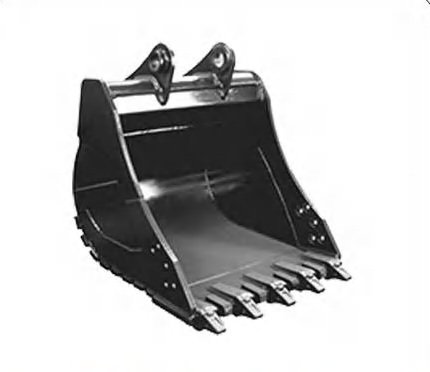
Qisheng lists a 400 mm bucket width for QS-12 and QS-18 and 420 mm for QS-25. If the specification calls for a narrower cut, ask for the actual proposed bucket and method. A drawing or quote for the standard bucket does not establish that a 300 mm finished trench will result.
Check the Working Envelope at the Proposed Position
The QS-18 and QS-25 catalogue maximum digging depths are 2,100 and 2,600 mm, with overall widths of 1,160 and 1,300 mm. Those numbers can begin the review, but the required trench shape and working position must also be within an appropriate arrangement.
A reach limit alone cannot determine where the excavator may stand beside an excavation. UK HSE's excavation guidance explains that loading from nearby plant can contribute to collapse and that support, services and adjacent structures need assessment before work starts.
Apply the site's actual requirements and local rules. This guide supplies no universal stand-off distance, slope angle, support design or permission to enter an unsupported excavation.
Match Powered Tools and Lifting as Separate Duties
For a breaker or auger, obtain the exact tool requirements and the supplied carrier's auxiliary ratings, connections and permitted controls. Engine power alone does not establish the usable auxiliary flow or pressure.
Suspended-load handling needs the applicable load chart, lifting point and complete arrangement. Do not infer capacity from model class, bucket force or a successful demonstration of ordinary digging. Qisheng's reviewed catalogue does not provide a complete lifting chart for each proposed configuration.
HSE's excavator lifting guidance distinguishes conventional earthmoving from lifting duties in the UK. Use that distinction when defining the task, and have the responsible competent person establish the requirements for the actual jurisdiction and machine.
Plan Site Movement and Acceptance Together
Identify the unloading point, travel routes, people, delivery vehicles and spoil collection area. A configuration that can reach the excavation still needs a workable route through the active site.
The HSE excavator overview identifies movement, slewing and the working attachment as separate hazards. Its UK guidance emphasizes selection, separation of people and machines, visibility and competent operation. Do not replace those site controls with the assumption that a compact machine is harmless.
Before accepting the order, agree what evidence will confirm the engine/options, tools, machine identity and required functions. Resolve missing hydraulic, lifting or transport information before relying on the configuration for the project.
Frequently Asked Questions
Can one machine complete every construction task?
Only if the actual machine, tools and site method meet each duty. A separate tool, carrier or specialist operation may be required for a task outside the approved arrangement.
How should I compare mini excavator work requirements?
Use task dimensions, material, working positions and the required result. Keep these inputs separate from an assumed output per hour.
Are a quick hitch and standard bucket enough?
That depends on the task. Confirm the complete attachment pairing, operating instructions and any additional requirements rather than treating a package name as the specification.
Related Construction Information
Use the concrete removal guide, attachment compatibility guide and transport plan. Browse mini excavator models after defining the tasks.
Send the Project Requirements
Give Qisheng Machinery the task schedule, access survey, required tools and destination. Ask the proposal to identify the specific configuration and the evidence still required for each duty.