Mini Excavator Grapple: Jaws, Rotation and Load
Qisheng Machinery · October 18, 2026
Quick Answer
Choose a mini excavator grapple around the objects to be handled, the jaw contact needed and the way those objects must be placed. Loose brush, individual logs and irregular stone create different gripping requirements. Then check the installed tool mass, carrier ratings and any separate hydraulic functions for clamping and rotation.
Begin with the largest and smallest regular objects, their actual mass and the receiving location. Jaw opening alone cannot establish a useful or permitted handling capacity.
Match the Jaw Arrangement to the Object
| Material or requirement | Tool detail to assess | Useful evidence |
|---|---|---|
| Individual logs | Jaw curve, closing contact and resistance to rolling | Representative object dimensions and the maker's permitted duty |
| Loose branches or brush | Tine spacing and overlap | Whether smaller pieces remain contained in an approved trial |
| Mixed irregular pieces | Jaw profile, contact and retention | Approved application and a suitable demonstration |
| Precise orientation when placing material | Rotation arrangement and control | Required movement, hose system and receiver clearance |
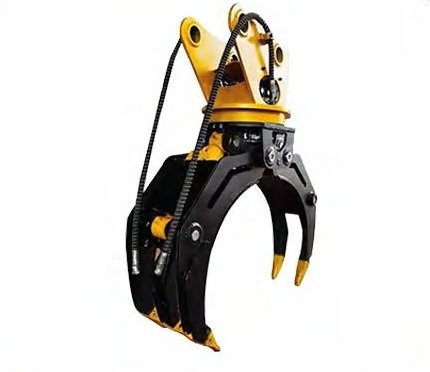
Qisheng's v9 accessories catalogue illustrates a mechanical log grab and a rotary wood grabber. A mini excavator grapple attachment quotation should identify which design is supplied, how it closes and how it is controlled. The two catalogue pictures do not establish the same installation or handling duty.
A standalone grapple also differs from a thumb that closes against a bucket. For a thumb-based arrangement, the bucket and thumb contact together; use the separate thumb installation guide when that is the proposed design.
Separate Opening, Tool Mass and Handling Capacity
Manufacturers may publish jaw opening, overall width and attachment mass as different measurements. Keep those labels separate. The width of a multi-tine tool does not tell you the largest log it can grip, and a large opening does not state an allowable payload.
For a named compact-machine example, Rata's VG075 Power Claw is listed with these figures:
| Published field | VG075 reference |
|---|---|
| Tool width | 0.75 m |
| Tool weight | 150 kg |
| Manufacturer's recommended excavator range | 1.5–3 ton |
These are Rata's figures, not a Qisheng grapple specification or approval on a QS machine. The recommended machine range is an initial manufacturer selection field. The supplied mount, installed assembly and intended duty still need confirmation.
When reviewing a proposed load, account for the tool, coupler or adapter and the handled object under the carrier's applicable ratings. The grapple's own mass uses part of the available allowance; the empty-tool weight cannot be treated as its payload rating. Obtain actual object mass instead of estimating a log's weight from diameter alone.
Specify Clamping and Rotation as Separate Functions
A mini excavator rotating grapple may need services for both jaw operation and the rotator. Ask the supplier to identify each function's required flow, pressure, return arrangement and control. Confirm how the functions are selected and whether they can be operated as required by the approved system.
When ordering a log grapple for a mini excavator, describe the intended placement: into a trailer, beside a processing area or into a defined stack. The space needed to turn a long object can be more important than the grapple's outside width.
Ask whether the rotator permits continuous rotation or a limited arc, and obtain the corresponding hose and swivel arrangement. A catalogue label showing rotation does not replace the supplied unit's instructions. The commissioning record should cover the actual grapple, rotator, mount and controls together.
For a representative trial, define the object, starting position and receiving position. Check the permitted grip and placement under the manufacturer's method. Keep people outside the handling area, and resolve slipping, interference or unintended movement before accepting the setup. A demonstration using loose brush does not establish a stone-handling or suspended-load rating.
Frequently Asked Questions
Is a rotating grapple always the better purchase?
Rotation is useful when placing objects at changing orientations is a recurring requirement. Compare that benefit with the installation, mass and control demands of the actual tool.
Can the same jaws handle branches and large logs equally well?
Check the contact geometry and tine spacing against both ends of your material range. A tool that grips one large object may allow small loose pieces to escape.
What should a grapple quotation include?
The identified tool and rotator, interface drawing, installed mass, hydraulic requirements, permitted duty, wear parts and commissioning scope. Include the object and placement task in the enquiry.
Related Guides and a Handling-Tool Quote
Review the rated-capacity information guide and attachment compatibility record. Compare QS-18, QS-25 and the catalogue options. Send Qisheng the material dimensions, known mass and receiving arrangement for a tool-specific review and quotation.