Mini Excavator Parts Diagram: Callouts to Part Numbers
A mini excavator parts diagram helps locate a component, but the number beside its picture may only be a callout. The orderable part number normally sits in a separate list, alongside its description and any applicability notes. Read the drawing and the list together.
Start with the correct machine, serial range and assembly. A clear drawing from a similar excavator can show how a joint works while still identifying the wrong replacement. For the information to collect first, see the parts and maintenance guide.
Distinguish the numbers on the page
| Field | What it identifies | What to record |
|---|---|---|
| Figure or assembly heading | The group shown, such as a bucket linkage or pump assembly | Catalogue title, revision and figure reference |
| Callout or reference number | A position in that particular illustration | The callout together with its figure; “item 7” alone is incomplete |
| Part number | The manufacturer’s ordering reference | Every character, suffix and revision shown |
| Description and notes | The item’s role and any variant, serial break or replacement instruction | The complete relevant row, including footnotes |
| Quantity | Depending on the catalogue, a fitted quantity or an order-entry field | The column heading and the quantity actually needed |
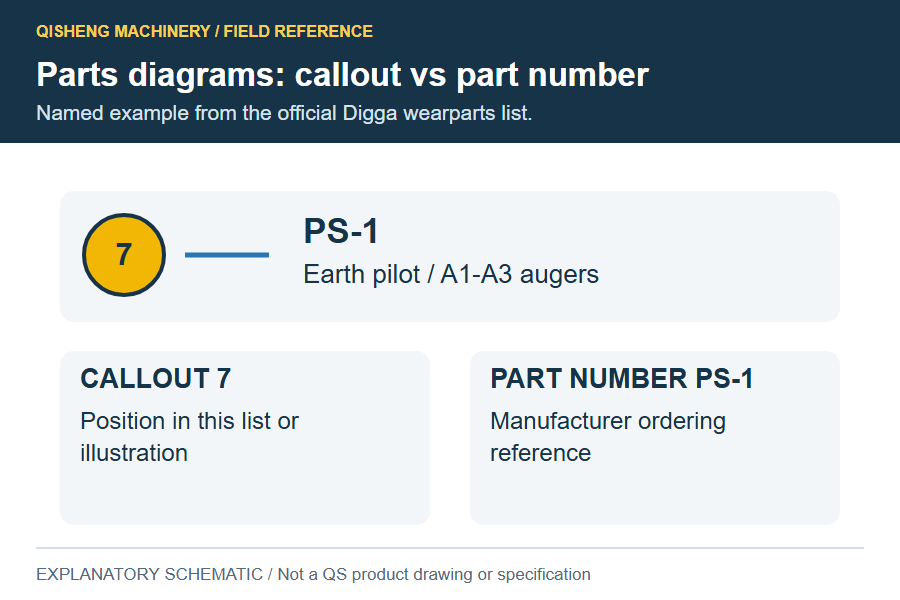
A real example: item 7 is not part number 7
In Digga’s auger wearparts list, row 7 identifies the earth pilot for A1/A3 augers as part PS-1. The displayed “7” locates the item in that list; PS-1 is the ordering reference. This is a Digga example, not a Qisheng part number.
Notice also that the page’s QTY column contains an order-entry box. It does not establish how many pilots are fitted to an auger. In another catalogue, a quantity column may mean parts per illustrated assembly. Check the convention before multiplying.
As a separate, hypothetical example, a list might show two bushes per pivot. Repairing three identical pivots would require six only if all three use that same assembly and all six bushes are being replaced. “Two in the drawing” is not automatically the whole-machine order quantity.
Check assemblies, serial breaks and replacements
An exploded view separates items so they can be seen. It does not promise that every illustrated washer, seal or internal piece is sold individually. A supplier may offer an assembly, a service kit or a replacement part with a changed reference.
- Confirm the figure matches the actual component and its mounting arrangement.
- Follow the callout to the list, then read the notes attached to that row.
- Check whether the catalogue divides production by serial number or configuration.
- Ask whether a superseding part replaces the old item alone or requires matching pieces.
- State whether the request is for one service item, a kit or the complete assembly.
Where a machine uses a separately manufactured engine or hydraulic unit, its own identification also matters. Kubota’s engine identification guidance explains that emissions information is not a substitute for the correct engine model and serial details. A machine model alone may leave several engine or pump variants unresolved.
Send a parts request the supplier can verify
Attach the full catalogue page and a readable close-up of the relevant row, rather than a cropped item number. Include the machine serial plate, component plate, installation photo, quantity and delivery country. For a pump, the pump identification guide explains the additional unit details that distinguish replacements.
For a Qisheng order, ask for the applicable parts reference using the machine’s serial number. Do not use an unlabelled online diagram as an approved QS catalogue. The quotation should confirm the part number, kit contents and any variant conditions.