Mini Excavator Skeleton Bucket: Gaps and Sorting
Qisheng Machinery · October 18, 2026
Quick Answer
A mini excavator skeleton bucket holds suitable larger pieces while some finer material passes through openings in its shell. Choose it by the separation result, material condition and clear openings, then check the tool's mass and carrier arrangement. A passive bar bucket offers a different process from a powered screening bucket or crusher.
Describe what should remain in the bucket and what should pass through. “Remove stones from soil” is incomplete without the relevant sizes, moisture condition and acceptable result.
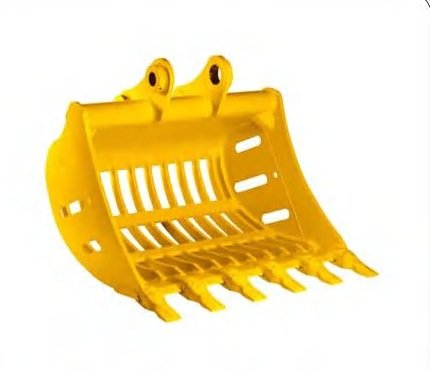
Read the Openings Before the Overall Width
Listings may use “skeleton excavator bucket,” “riddle bucket” or “sorting bucket” for related designs. Ask for a drawing rather than relying on those names. GRAXX's sorting-bucket description identifies stone, debris and coarse aggregate as intended materials in its range; an individual model still needs its own specification.
| Measurement | Meaning | Why the distinction matters |
|---|---|---|
| Clear opening | Unobstructed space between bars or plates | Closest geometric starting point for the proposed separation |
| Bar pitch | Distance between corresponding points on adjacent bars | Includes bar material as well as the gap |
| Bar thickness | Material occupying part of the pitch | Changes the clear space and structure |
| Bucket width | Overall or cutting width, as stated | Describes the tool envelope rather than the sorting opening |
As a hypothetical drawing example, bars on an 80 mm centre-to-centre pitch with 20 mm bar thickness leave a 60 mm clear gap in that direction. This subtraction assumes the stated parallel-bar geometry. It is not a dimension of Qisheng's pictured bucket or a promise of an exact 60 mm material cut.
Record the openings in both relevant directions where crossbars are present. Reinforcement, wear and the shape of the opening can also change how material passes.
Account for Material Shape and Moisture
A long, narrow fragment can pass through a slot even when its length exceeds the gap. A damp clod containing fine soil may remain with the larger pieces. Roots and fibrous debris can bridge openings. These are reasons to inspect representative material rather than treat a nominal spacing as a guaranteed grading result.
| Material condition | Question to resolve in a trial |
|---|---|
| Relatively dry, loose mixed material | Does the retained fraction meet the intended separation? |
| Damp cohesive clods | How much usable fine material remains trapped in clods? |
| Long roots or branches | Do they bridge openings or pass with the fine fraction? |
| Mixed hard debris | Is the material permitted for the tool and the reuse destination? |
Identify any contamination or unsuitable waste before considering reuse. A bucket's mechanical separation does not establish that the resulting material meets a construction, environmental or disposal specification.
Qisheng's accessories page illustrates a skeleton bucket but does not state its clear openings, empty mass or rated capacity. Ask for those values on the supplied model. When choosing a skeleton bucket for a mini excavator, check the pin or coupler interface and permitted loading against the actual carrier.
Agree a Sample Test and Record Both Fractions
Select a sample representative of the actual work, including the expected moisture and debris. Agree the material, permitted tool method and the result to be assessed before the demonstration. The operator should follow the bucket and carrier instructions; violent shaking is not a substitute for a suitable screening process.
Record the input, retained material and passed material using a consistent basis. If using mass, keep the measurement basis and moisture condition clear. If using container volume, identify the containers and filling method rather than mixing those figures with a mass result.
Photograph both fractions and note oversize fragments in the passed material or fines retained in clods. The useful acceptance question is whether that output meets the intended next use. A visually clean bucket or a short video does not establish a production rate for the entire site.
If the passive bucket cannot produce the required separation, discuss a suitable screening process or different handling method. Keep powered-screening installation requirements separate from the fixed skeleton bucket order.
Frequently Asked Questions
Is a skeleton bucket the same as a rake?
A rake primarily gathers or separates suitable debris across a surface. An excavator skeleton bucket also contains material within a bucket-shaped shell. Choose against the required handling and separation process.
Will everything smaller than the stated gap fall through?
Material shape, moisture, clods and bridging affect the result. Confirm how the supplier defines the gap and assess a representative sample.
Does the bucket crush larger pieces to fit?
A fixed bar bucket is a passive separating tool. Crushing or powered screening requires equipment specifically designed and approved for that process.
Related Tools and a Sorting-Bucket Enquiry
Read the bucket and rake overview and bucket measurement guide. Review QS-12, QS-18 and the accessory catalogue. Send Qisheng your material description and desired retained fraction so the quotation identifies the openings and proposed carrier arrangement.