Mini Excavator Tilt Bucket: Angles and Grading Fit
Qisheng Machinery · October 18, 2026
Quick Answer
A mini excavator tilt bucket changes the cutting edge's angle relative to the stick, making it useful to assess for ditch finishing, shaping and other defined grading tasks. Compare an integrated tilting bucket with a tilting coupler or tiltrotator according to the tools you need to move and the functions available on the machine.
Keep the bucket's tilt travel separate from the required ground profile. A stated attachment angle does not establish a safe machine slope, finished drainage grade or permitted working position.
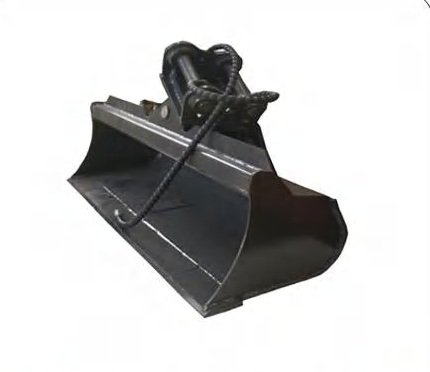
Choose Which Part of the Assembly Should Tilt
| Arrangement | What moves | Useful selection question |
|---|---|---|
| Integrated hydraulic tilt bucket | The bucket tilts through its own mechanism | Is this the only tool that needs angle adjustment? |
| Tilting coupler | A compatible attached tool tilts with the coupler | Which existing tools are approved for the system? |
| Tiltrotator | The specified system adds tilt and rotation | Does the work justify the extra functions, mass and controls? |
A mini excavator tilt grading bucket can address a recurring finishing requirement without specifying a rotating head for every tool. Conversely, a business using several approved tools at changing angles may have a reason to assess a coupler-based system. The coupler selection guide distinguishes locking and connection functions. Compare the complete assemblies and installation requirements.
Qisheng's accessories page illustrates a hydraulic tilting bucket, a swing hydraulic quick-change tool and a separate rotary bucket. They are distinct catalogue entries. Request the function and model of the actual offered item instead of treating the illustrations as one interchangeable system.
Understand the Angle and Bucket Dimensions
As a named design example, Werk-Brau's hydraulic tilting bucket is described as tilting up to 45 degrees left and 45 degrees right. That is a total travel span of 90 degrees between the stated endpoints, not 90 degrees to each side. This is Werk-Brau's description; Qisheng's illustrated bucket needs its own confirmed limits.
| Specification | Read it as | Ask the supplier to clarify |
|---|---|---|
| Tilt left / right | Separate limits relative to the defined neutral position | Drawing, stops and any restricted configurations |
| Cutting-edge width | Width of the working edge | Overall width and any bolt-on edge projection |
| Empty mass | Mass of the stated bucket version | Coupler and adapter items included or excluded |
| Capacity | Material volume under the maker's stated method | Struck or rated definition and applicable material |
| Installed geometry | Complete carrier-to-edge arrangement | Clearances, tip position and hose movement |
For a compact excavator tilt bucket, a wider edge may cover more surface but also changes the tool's mass and loading. Compare it with the job's access, material and permitted bucket arrangement. Keep those decisions tied to the actual carrier rather than selecting from width alone.
Match the Hydraulic Function to the Finish Required
When specifying a tilt bucket for a mini excavator, identify how the operator controls both tilt directions, how the cylinder is protected and how the hoses move through the assembly's permitted range. Obtain the manufacturer's flow, pressure, connection and protection requirements.
A connection that looks like the machine's breaker outlet is not a complete hydraulic specification. Have the installer confirm the required circuit and controls for the selected bucket. The compatibility checklist covers the common information record without replacing the installation manual.
Describe the finishing result in the enquiry: the profile drawing, material, access and the location from which the machine will work. Ask whether the edge, bucket shape and movement range suit that arrangement. Where the finish has a specified tolerance, agree how the completed surface will be checked.
A demonstration should use an approved setup and a representative finishing task. Observe edge control, hose clearance, visible leakage and the resulting profile under the maker's prescribed checks. A successful unloaded tilt demonstration verifies movement, while the finishing task needs its own acceptance evidence.
Frequently Asked Questions
Is a tilt bucket the same as a tiltrotator?
No. Identify which assembly tilts and whether a separate rotation function is provided. The names describe different tool arrangements.
Can I use the tilt-angle figure as a slope limit?
No. Machine positioning and permitted slopes come from the applicable machine instructions and site assessment. The bucket's movement range answers a different question.
Should I order the widest finishing bucket available?
Choose the edge width that fits the repeated task and the approved machine arrangement. Include the full installed mass and working geometry in the review.
Related Guides and a Finishing-Tool Enquiry
Use the ground-finishing guide for project questions and the bucket dimension guide for measurement definitions. Compare QS-18, QS-25 and the options catalogue. Send Qisheng your required profile and tool arrangement for a defined bucket and installation quote.