Rubber Tracks for Mini Excavator: Buying and Care Guide
Qisheng Machinery · Updated October 16, 2026
Quick Answer
Replacement rubber tracks for mini excavator use need more than the machine's tonnage or belt width. Identify the machine, the existing track marking, width, pitch, section or link count and guide arrangement. Have the supplier confirm the complete fit before ordering, particularly if the undercarriage or tracks have been changed before.
Qisheng's catalogue track length and width entries are useful machine references. They are not a complete closed-loop belt code and should not be used alone to order a replacement.
Read a Complete Track Specification
A real manufacturer example shows why the fields matter. Caterpillar lists part 367-4063 as 180 mm wide, with 37 mm pitch and 72 sections. Its description identifies the 300.9D and 300.9VPS applications. Those figures illustrate a named Cat part; they do not establish compatibility with QS machines.
| Identification field | What to record | What it does not establish alone |
|---|---|---|
| Machine identity | Maker, model, serial and any undercarriage changes | A model name may cover different supplied parts |
| Track marking | Every readable character and a close photograph | A partly readable code is not a confirmed match |
| Belt width | Confirmed width and units | Width does not establish pitch or guide fit |
| Pitch and count | Manufacturer-defined pitch and section/link count | Do not infer these from an overall machine-track length |
| Inner guide and drive arrangement | Supplier-confirmed design and identifying photos | Similar external tread does not prove the same inner geometry |
| Supplied quantity | One belt or a pair, with the stated specification | A quoted price may cover different quantities |
Use the manufacturer's terminology when recording pitch and count. If the marking has disappeared, provide the supplier with machine identification and the requested measurements or photos. Do not work under an unsupported machine to obtain them.
Use the QS Catalogue as a Cross-Check
| Qisheng v9 catalogue series | Listed track width | Information still needed for a belt order |
|---|---|---|
| QS-12 | 180 mm | Actual part identity, pitch, count and guide compatibility |
| QS-18 | 230 mm | Actual part identity, pitch, count and guide compatibility |
| QS-25 | 250 mm | Actual part identity, pitch, count and guide compatibility |
Source: Qisheng catalogue, October 9, 2026. These rows do not mean that every belt of the stated width fits the corresponding series. For example, the Cat belt above also has a 180 mm width; that shared dimension does not make it a QS-12 replacement.
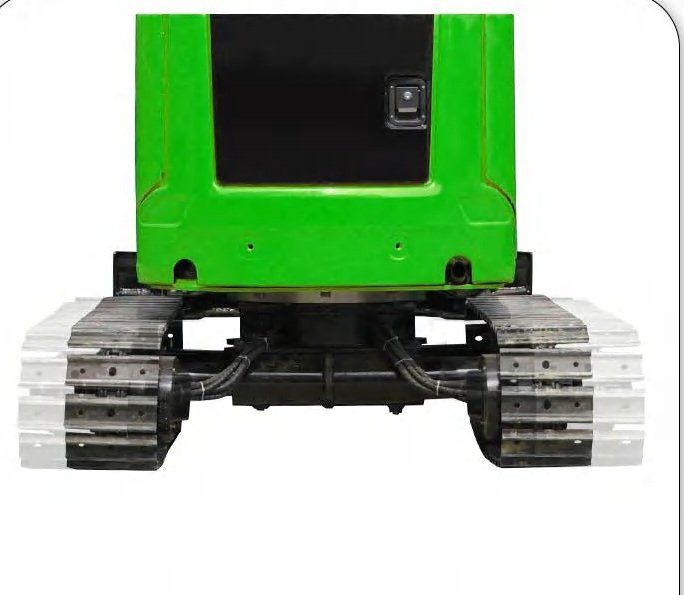
The catalogue also describes optional retractable tracks. An option name or a photograph does not identify the replacement belt or prove that another width will fit the ordered configuration.
Include the Undercarriage in the Enquiry
A new belt does not resolve a worn drive system by itself. Camso's mini-excavator guidance calls for inspection of associated components when tracks are replaced and warns that a worn system can shorten the new track's life.
Include photos of the sprocket, rollers, idler and damaged area when requesting an assessment. State whether the problem is wear, cutting, repeated de-tracking or an unidentified replacement. That gives the supplier a more useful starting point than "send a stronger track."
Ask whether the quoted scope includes only belts or also identified wear components and installation work. Do not order every associated part automatically; obtain the inspection findings and the parts actually required.
Check the Delivery before Installation
Compare the received product marking, quantity and confirmed specification with the order. Keep the packaging label and part photographs in the machine record. If the product does not match, resolve the difference before attempting installation.
Obtain the machine-specific installation and tensioning instructions, including required support and measuring conditions. The track adjuster's grease connection is not an ordinary lubrication point. This buying guide does not supply a universal pressure-release or track-removal procedure.
For ongoing care, make damage and undercarriage observations part of the service record. The separate rubber-track life guide explains how to use that history. For changing the type of system, start with the rubber versus steel comparison.
Compare the tread and the route after confirming belt fit
Once the belt fit has been confirmed, describe the surfaces and turning conditions to the supplier. A tread name or photograph is not enough to establish traction, ride or surface-marking performance on the proposed machine. Ask which pattern is available for the identified belt and which working conditions it is intended for; keep that choice separate from width, pitch and guide compatibility.
Photograph the worn pattern and record where cuts, missing lugs or repeated damage occur. That history gives the supplier a clearer enquiry than asking for a “more aggressive” tread without describing the work. If the machine instead has steel shoes with replaceable pads, use the rubber track-pad mounting and ordering guide. Qisheng can supply rubber pads after the actual shoe or chain fit is confirmed.
Frequently Asked Questions
Can I order by width and machine class?
Those fields are insufficient. The exact belt design, pitch, count and applicable machine configuration need confirmation.
Is the catalogue's track length the belt circumference?
Do not treat it as a replacement-belt circumference or calculate a link count from it. Obtain the actual belt specification for the supplied machine.
Must both tracks and all sprockets be replaced together?
The appropriate scope depends on the actual parts and inspection findings. Request a documented assessment rather than a blanket replacement rule.
Request an Identifiable Replacement
The parts and maintenance record covers the machine and component information needed for a parts request. For a new machine, compare the QS-12 and QS-18 specifications.
Send Qisheng the model, serial, readable belt markings and relevant photographs. Ask for written confirmation of the replacement specification and the inspection or installation scope.