Compact Excavator Attachments: Best Options
Qisheng Machinery · Updated October 16, 2026
Quick Answer
Choose compact excavator attachments by the material to be handled and the finished result. Digging, spreading, separating debris, gripping irregular objects and drilling holes are different tasks, even when they happen on the same property.
The best option is the tool that performs your repeated task on an approved carrier setup. A long attachment list does not establish suitability, and no single “best package” covers every farm or landscaping site.
Start with the Result, Then Compare Tools
| Required result | Tool type to assess | Information that changes the choice |
|---|---|---|
| Excavate a defined trench | Suitable digging or narrow bucket | Designed trench width, ground and permitted bucket arrangement |
| Spread loose material and finish a surface | Suitable grading or toothless bucket | Working width, surface, access and machine control |
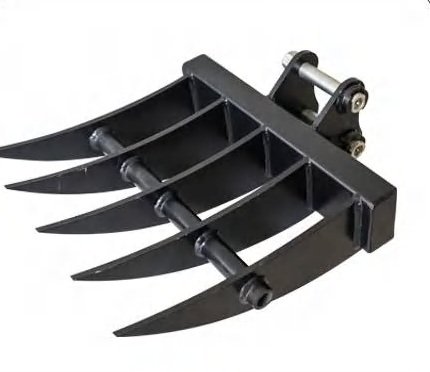
| Gather loose woody debris while allowing some soil through | Rake | Tine spacing, debris size and soil condition |
| Separate suitable larger material from finer material | Skeleton bucket | Opening size, material moisture and required separation |
| Grip an irregular object against a bucket | Compatible thumb | Bucket geometry, object shape and permitted handling duty |
| Make specified holes | Matched auger assembly | Diameter, depth, ground, drive and carrier requirements |
Qisheng's v9 optional-accessory page illustrates these types, including a rake, skeleton bucket, toothless bucket, auger, mechanical thumb and hydraulic thumb clamp. A catalogue option still needs confirmation for the exact QS model and configuration.
A task description is more useful than a request for “all attachments.” For example, removing soil from a drainage trench and gathering loose branches afterwards calls for two different results. A rake does not contain excavated soil like a digging bucket.
Distinguish Digging, Finishing and Sorting
For digging, specify the excavation dimensions and the ground. For finishing, specify the surface and material to be spread. A grading bucket's broad edge does not make it a suitable tool for breaking hard ground, nor does a narrow bucket automatically suit every trench.
The catalogue digging buckets for QS-12 and QS-18 are listed at 400 mm wide; QS-25 is listed at 420 mm. Optional bucket dimensions need separate confirmation. These are cutting-width references, not capacity, mounting or productivity ratings. The bucket width and capacity guide explains those distinctions.
Rakes and skeleton buckets also differ. A rake can gather suitable loose debris across a surface. A skeleton bucket can retain some material while finer material passes through its openings. Neither promises complete separation: wet clods, roots and fragments may behave differently. State the material and desired separation size before selecting an opening or tine arrangement.
Match Gripping Tools to the Object
A thumb works with the bucket to restrain suitable irregular objects. Compare the actual bucket/thumb contact and movement, rather than selecting only by jaw width. A separate grapple has a different arrangement and may require additional controls or rotation services.
As a named design example, Werk-Brau says its main-pin thumb is matched to the bucket tip radius and machine setup, including the coupler arrangement. That supports checking the complete geometry; it does not approve a Werk-Brau or Qisheng thumb on an unspecified machine.
A thumb is not an automatic lifting attachment for every load. Obtain the carrier and attachment instructions for the intended handling duty. Object mass, grip, working position and the installed tool assembly all matter. Do not infer an allowable log or rock weight from a photograph.
Rank Options for a Real Work Sequence
Consider a hypothetical landscaping sequence: excavate a drainage run, spread suitable loose backfill, gather branches, then drill a small number of specified holes. First retain a bucket that meets the excavation requirement. Next assess the finishing tool if that work recurs. Add a rake if loose debris gathering is a repeated need, and review an auger assembly against the actual hole specification.
This is a selection example, not a customer case or a production forecast. A site with frequent drilling and very little grading could produce a different priority order.
Record how often each task occurs, what the current method fails to achieve and where the new tool would be used. Where practical, an approved demonstration in representative material can answer more than an attachment photograph. Keep purchase timing and missing connection parts in the separate attachment-package guide.
Frequently Asked Questions
Which attachment should I buy first?
Address the repeated task your current equipment cannot perform adequately. That may be a different bucket, a gripping tool or a drill assembly; a quick hitch is not automatically the first purchase.
Is a rake the same as a skeleton bucket?
No. Compare how the tool gathers or holds material, its openings and the intended result. Similar-looking tines do not establish equal duty.
Can I choose attachments by machine tonnage?
A size class can narrow the search, but it does not confirm the mounting, hydraulics, mass or geometry. Use the machine-and-tool compatibility checklist for the selected pair.
Related Guides and Machine Options
Detailed tool selection: Mini Excavator Ripper: Tooth, Shank and Ground Fit; Mini Excavator Grapple: Jaws, Rotation and Load; Mini Excavator Skeleton Bucket: Gaps and Sorting.
For vegetation cutting and pallet handling: Mini Excavator Brush Cutter: Disc or Flail Head?; Mini Excavator Pallet Forks: Fit and Load Information; Mini Excavator Hedge Trimmer: Cutter Bar and Job Fit.
Read the bucket and rake comparison for those tasks, or browse QS mini excavators when choosing a carrier.
Describe the Work to Qisheng Machinery
Send the task, material and current machine details, with photos where useful. Include the result you need and how often the work occurs, so the proposed tool addresses a specific problem.